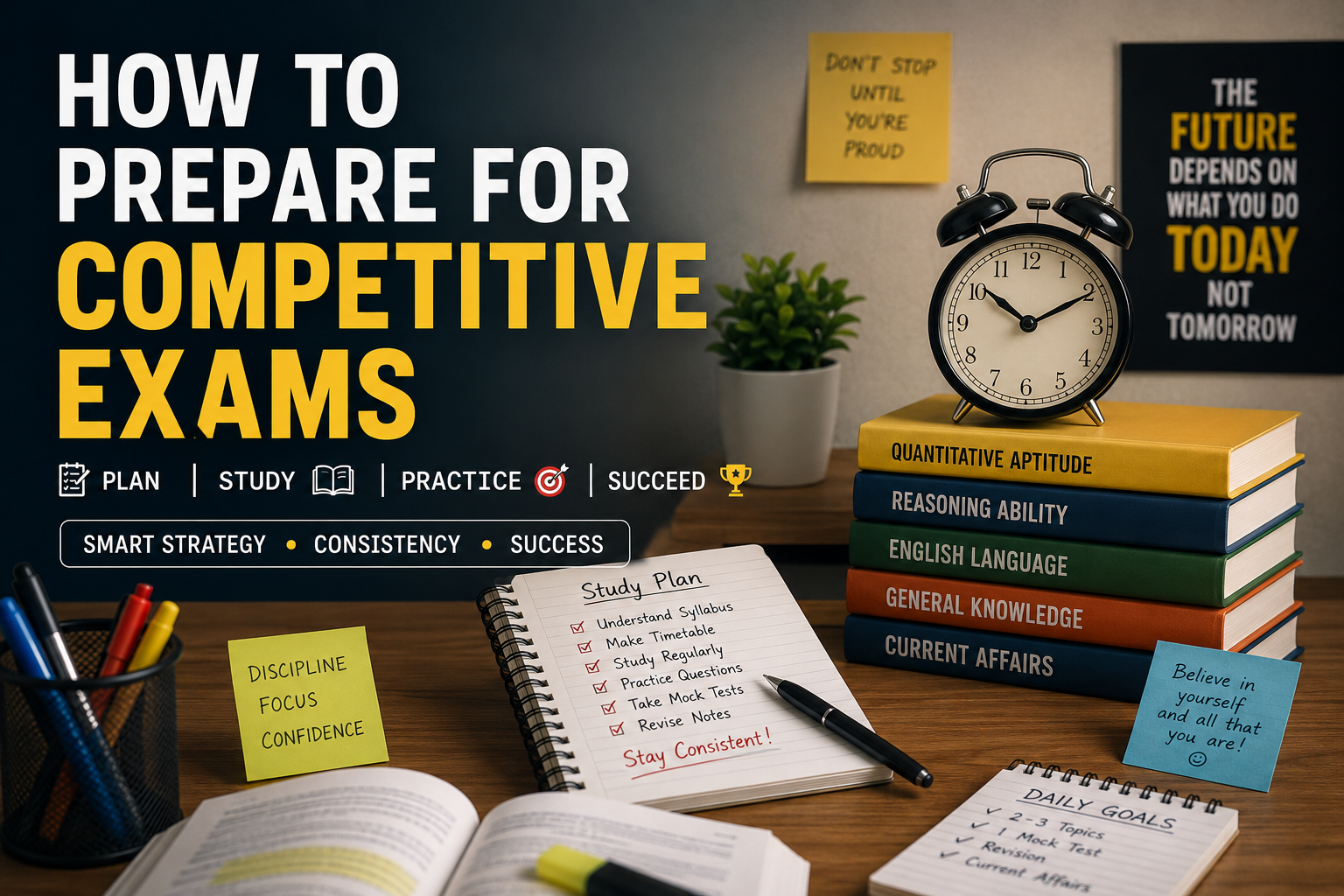
Preparing for competitive exams can feel overwhelming, but with the right strategy, discipline, and mindset, you can significantly improve your chances of success. Whether you’re preparing for civil services, banking, SSC, railway, engineering, medical entrance exams, or other government recruitment tests, a structured approach is the key to achieving your goals.
Why Competitive Exams Require a Different Approach
Unlike school or college exams, competitive exams test your understanding, analytical thinking, speed, accuracy, and consistency. Since thousands or even millions of candidates compete for limited seats, preparation should focus on outperforming others rather than simply passing.
Some common competitive exams include:
- UPSC Civil Services
- State PSC Exams
- SSC CGL & CHSL
- Banking (IBPS, SBI, RBI)
- Railway Recruitment Board (RRB)
- CUET
- NEET
- JEE
- CAT
- GATE
- OPSC ASO and other state-level exams
1. Understand the Exam Pattern and Syllabus 📝
Before opening your first book, understand exactly what the exam demands.
Study:
- Complete syllabus
- Exam pattern
- Number of questions
- Marking scheme
- Negative marking
- Time duration
- Previous year’s cut-off
Print the syllabus and keep it on your study desk. It becomes your preparation roadmap.
2. Create a Realistic Study Plan 📅
Avoid studying randomly.
A good timetable should include:
- Daily study goals
- Weekly revision
- Monthly mock tests
- Current affairs
- Practice sessions
- Rest and exercise
Sample Daily Routine
| Time | Activity |
|---|---|
| 6:00–7:00 AM | Revision |
| 7:00–9:00 AM | Difficult Subject |
| 10:00–1:00 PM | Concept Learning |
| 2:00–4:00 PM | Practice Questions |
| 5:00–6:00 PM | Current Affairs |
| 7:00–9:00 PM | Mock Test/Revision |
3. Choose the Right Study Materials 📚
Using too many books creates confusion.
Instead:
- Start with standard textbooks.
- Follow one reliable current affairs source.
- Use previous year papers.
- Solve quality mock tests.
- Make your own notes.
Quality always beats quantity.
4. Build Strong Fundamentals 🧠
Competitive exams increasingly test concepts rather than memorization.
Focus on:
- Understanding principles
- Learning formulas
- Practicing applications
- Solving conceptual questions
Strong basics help tackle difficult questions confidently.
5. Solve Previous Year Question Papers
Previous papers help you:
- Identify important topics
- Understand question trends
- Improve speed
- Learn time management
Aim to solve at least the last 5–10 years of question papers.
6. Practice Mock Tests Regularly ⏱️
Mock tests simulate the real exam environment.
Benefits include:
- Better time management
- Increased accuracy
- Reduced exam anxiety
- Performance analysis
After every mock test:
- Review mistakes.
- Note weak areas.
- Revise concepts.
- Retry incorrect questions.
7. Make Effective Notes ✍️
Short notes save revision time.
Include:
- Important formulas
- Key facts
- Dates
- Definitions
- Tricks
- Shortcuts
Use color coding and mind maps to improve retention.
8. Revise Frequently 🔄
Without revision, most information is forgotten.
A simple revision cycle:
- First revision: Within 24 hours
- Second revision: After 7 days
- Third revision: After 30 days
Frequent revision strengthens long-term memory.
9. Improve Speed and Accuracy
Competitive exams reward both speed and precision.
Practice:
- Timed quizzes
- Mental calculations
- Reading comprehension
- Logical reasoning
- Shortcuts where appropriate
Avoid guessing if the exam has negative marking.
10. Stay Updated with Current Affairs 📰
For exams with General Awareness sections:
Read daily about:
- National news
- International events
- Economy
- Science and technology
- Government schemes
- Environment
- Awards
- Sports
Maintain a monthly current affairs notebook.
11. Focus on Weak Areas
Everyone has strengths and weaknesses.
Spend more time improving weaker subjects while maintaining your stronger ones.
Track your progress weekly and adjust your study plan as needed.
12. Stay Healthy 💪
A healthy body supports a focused mind.
Maintain:
- 7–8 hours of sleep
- Balanced diet
- Regular exercise
- Adequate hydration
- Short breaks during study sessions
Avoid excessive caffeine and junk food.
13. Avoid Common Preparation Mistakes
Many aspirants fail because they:
- Ignore the syllabus
- Skip revision
- Use too many resources
- Study without practice
- Avoid mock tests
- Compare themselves constantly with others
- Study for long hours without concentration
Focus on consistent, effective study rather than simply spending more time.
14. Manage Exam Stress
Stress is natural but manageable.
Helpful techniques:
- Deep breathing
- Meditation
- Walking
- Listening to calming music
- Talking with supportive friends or family
- Maintaining realistic expectations
Confidence comes from preparation.
15. Prepare for Exam Day
Before the exam:
- Pack required documents.
- Check the exam center location.
- Sleep well the previous night.
- Eat a light, healthy meal.
- Reach the center early.
During the exam:
- Read instructions carefully.
- Start with easier questions.
- Keep track of time.
- Avoid spending too long on a single question.
- Review your answers if time permits.
Subject-Wise Preparation Tips
Quantitative Aptitude
- Learn formulas thoroughly.
- Practice arithmetic daily.
- Improve calculation speed.
- Solve mixed-topic questions.
Reasoning
- Practice puzzles regularly.
- Focus on logical thinking.
- Improve visualization skills.
- Solve timed reasoning sets.
English
- Read newspapers and books.
- Learn new vocabulary.
- Practice grammar.
- Improve reading comprehension.
General Knowledge
- Revise static GK.
- Read current affairs daily.
- Memorize important facts using mnemonics.
- Solve quizzes frequently.
Time Management Tips
- Set daily goals.
- Follow the Pomodoro Technique (25–50 minutes of focused study followed by a short break).
- Avoid multitasking.
- Turn off unnecessary notifications.
- Prioritize difficult subjects when you’re most alert.
Motivation Tips
Preparation is a marathon, not a sprint.
Remember:
- Every small study session adds up.
- Consistency beats occasional long study hours.
- Learn from mistakes instead of fearing them.
- Celebrate small milestones to stay motivated.
Essential Resources
A balanced preparation plan should include:
- Official syllabus
- Standard textbooks
- Previous year papers
- Mock test series
- Current affairs magazines or newspapers
- Self-made revision notes
Final Month Strategy
During the last month:
- Revise notes daily.
- Take full-length mock tests.
- Analyze mistakes after each test.
- Focus on weak topics without neglecting strengths.
- Avoid starting entirely new subjects.
- Maintain a healthy sleep schedule.
Conclusion 🎓
Success in competitive exams is built on disciplined preparation, consistent practice, regular revision, and a positive mindset. Rather than studying for long hours without direction, focus on understanding concepts, solving questions, analyzing your performance, and continuously improving. Every mock test, revision session, and small daily effort brings you closer to your goal. Stay patient, trust your preparation, and remain consistent—the results will follow.