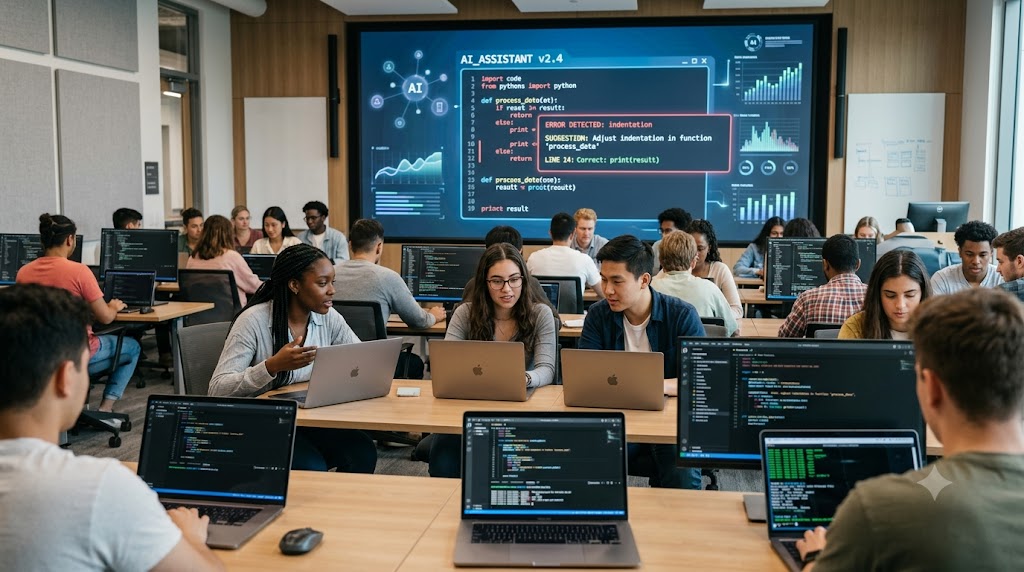
How artificial intelligence is changing Python education, helping students debug code, and reshaping the future of personalized learning
Introduction: A New Era of Programming Education 🤖
Learning to program is an exciting journey, but it can also be frustrating. A beginner may understand a Python lesson in theory yet struggle when asked to write a working program. A missing colon, an incorrect variable, a logical error, or a misunderstanding of a loop can prevent an entire program from running. For many students, the greatest challenge is not writing code but understanding why their code does not work.
Traditional programming education often relies on lectures, textbooks, laboratory exercises, compiler messages, and feedback from teachers. These methods remain essential, but they have practical limitations. Teachers may need to support dozens or hundreds of learners, and students sometimes wait hours or days before receiving detailed explanations of their mistakes.
Artificial intelligence (AI) is creating a new opportunity to address this challenge. AI-powered teaching systems can analyze student questions, explain programming errors, suggest improvements, and provide personalized learning support. Instead of giving every student the same explanation, these tools can adapt their responses to individual questions and difficulties.
A study published in Scientific Reports on October 14, 2026, examined an AI-augmented teaching approach in an undergraduate Python programming course. The researchers studied 120 students divided between an AI-supported class and a class receiving conventional instruction. After adjusting for baseline differences, they reported higher scores in the AI-supported class across several academic performance measures. They also observed improvements in learning engagement, while acknowledging limitations associated with the study design. <escape>Read the original research</escape>.
These findings raise an important question: Can personalized AI feedback genuinely improve programming skills, or does it simply make assignments easier to complete?
The answer requires a closer look at the research, the educational benefits of AI, the risks of overdependence, and the conditions under which technology can support meaningful learning.
Understanding AI-Powered Teaching in Programming Education
AI-powered teaching refers to the use of artificial intelligence to support instruction, explain concepts, assess learning, and provide guidance tailored to students’ needs. In programming education, these systems may act as virtual teaching assistants that help learners understand code and develop problem-solving abilities.
Unlike a conventional textbook, an AI assistant can respond to a student’s specific question. A student who does not understand a Python loop can request a simpler explanation, ask for another example, or explore a similar problem. Someone who encounters a syntax error can share the relevant code and ask for help identifying the problem.
AI-supported teaching may combine several functions, including question answering, code diagnosis, personalized recommendations, and monitoring of learning activities. These functions can be integrated into a course rather than offered as an unrelated chatbot.
For example, a student learning Python functions might receive an explanation of parameters and return values, followed by a small coding exercise. If the student makes a mistake, the system can identify the likely source of confusion and recommend another exercise.
The most valuable feature is not simply the speed of the response. It is the possibility of delivering feedback that addresses a learner’s immediate difficulty while helping them understand the underlying concept.
However, AI is not automatically an effective teacher. The quality of its explanations, the design of the learning environment, and the student’s willingness to think independently all influence the outcome.
Why Personalized Feedback Matters When Learning Python
Personalized feedback is information that responds to an individual’s performance, errors, understanding, or learning needs. In programming, this can be especially valuable because students often make different mistakes while working on the same exercise.
One learner may misunderstand indentation, another may confuse assignment with comparison, and a third may write syntactically correct code that produces the wrong answer. A general explanation of Python syntax may not solve all three problems.
Personalized feedback helps connect an error to the concept that needs attention.
Consider a beginner who writes the following program:
age = input("Enter your age: ")

if age >= 18:
    print("Adult")
The program produces an error because input() returns a string, while the comparison expects a number. A helpful AI tutor could explain the difference between strings and integers, demonstrate how to convert the input, and invite the student to try again.
age = int(input("Enter your age: "))

if age >= 18:
    print("Adult")
A strong teaching response would also explain why the correction works. Simply supplying the replacement code might help the student finish the task without teaching them how to recognize the same problem in the future.
Personalized feedback can therefore support several learning needs:
- Conceptual understanding: explaining why a particular programming rule matters.
- Error recognition: helping students identify syntax, runtime, and logical errors.
- Skill development: recommending exercises based on demonstrated weaknesses.
- Confidence: making it easier to ask questions without fear of embarrassment.
- Independent problem-solving: guiding students toward a solution rather than immediately completing the task for them.
When these elements are carefully combined, feedback becomes more than error correction. It becomes a structured part of the learning process.
Inside the October 2026 Study: What Did Researchers Discover? 📊
The October 14 study, titled Course-embedded AI-augmented teaching is associated with engagement and performance in software education, investigated whether integrating an AI teaching assistant into an undergraduate Python course could support better learning outcomes.
The researchers, Zhe Gai, Junjun Wang, and Jinyong Wu, conducted a course-level quasi-experimental study involving two existing classes, each containing 60 students. One class used an AI-augmented teaching platform, while the other followed conventional instruction without access to that platform.

The AI-supported class used a large language model teaching assistant restricted to course-specific materials and instructional rules. Its functions included answering questions, diagnosing code, providing personalized recommendations, and allowing teachers to monitor learning activities.
The conventional class received the same course instruction without access to the AI platform. This comparison allowed the researchers to examine differences between the two teaching approaches within the course setting.
Key findings from the research
120 undergraduate students
Two existing classes of 60 students each participated in the study.
Higher adjusted learning scores
The AI-supported class achieved higher adjusted post-test, programming assignment, and final composite scores.
Improved learning engagement
Overall and behavioral engagement showed clearer gains in the AI-supported class.
Concerns remained
Students valued immediate feedback and debugging assistance but raised concerns about accuracy, dependence, and ethical boundaries.
An important detail is that the intensity of AI use was moderately associated with engagement but only weakly associated with academic performance. The findings therefore do not establish that using AI more frequently necessarily produces better programmers.
The researchers also reported evidence that engagement helped explain some of the relationship between AI-supported teaching and project-practice performance. However, evidence for a similar indirect pathway in final composite performance was less clear.
These results are encouraging, but they should be interpreted carefully. Because the study compared existing classes rather than randomly assigning individual students to different teaching conditions, differences between classes may have influenced the results. Statistical adjustment helps address measured baseline differences, but it cannot eliminate every possible source of bias.
The study supports the potential value of course-integrated AI teaching. It does not prove that AI will improve outcomes in every programming course or for every student.
How AI Feedback Can Help Students Learn Programming Faster
Immediate explanations reduce waiting time
One of the most frustrating parts of learning to code is encountering an error without understanding its cause.
In a traditional classroom, students may need to wait until a teacher or teaching assistant becomes available. This delay can interrupt concentration and make a relatively small mistake feel like a major obstacle.
AI assistants can respond to questions while students are working. They can explain error messages, clarify unfamiliar concepts, and suggest ways to investigate a problem.
For example, a beginner who receives a NameError might learn that Python cannot find a variable or function with the specified name. The tutor can encourage the student to check spelling, capitalization, and where the variable was defined.
This immediate support can help maintain momentum. However, faster answers are educationally valuable only when they help students understand what went wrong rather than simply remove the obstacle.
Debugging becomes a learning opportunity
Debugging is the process of identifying, understanding, and correcting problems in a program. It is one of the most important skills a programmer develops.
Beginners frequently assume that a program is either correct or incorrect. More experienced programmers learn to investigate problems systematically, test assumptions, examine outputs, and isolate the source of an error.
AI can support this process by explaining possible causes and suggesting diagnostic steps.
Imagine a student writing a program to calculate the average of five numbers. The program runs, but the result is unexpectedly low because the total is divided by six instead of five.
A useful AI response would help the student compare the number of values added with the divisor, test the calculation with smaller examples, and identify the inconsistency.
The goal should be to teach a repeatable debugging method. Students need to learn how to examine their own code, interpret evidence, and verify corrections independently.
Difficult concepts can be explained in different ways
Programming requires students to understand abstract ideas such as variables, loops, functions, recursion, data structures, and algorithms.
A single classroom explanation may not work equally well for everyone. Some learners prefer visual examples, others benefit from practical analogies, and others need several exercises before a concept becomes clear.
AI systems can provide alternative explanations on demand.
For example, a Python loop can be explained as a repeated instruction, illustrated with a small program, and then demonstrated through a step-by-step trace of changing variable values.
A student who does not understand the first explanation can ask for a simpler example or request a comparison between a for loop and a while loop.
This flexibility may make programming more accessible to learners with different backgrounds and levels of confidence.
Personalized exercises can target weaknesses
Students do not all learn at the same pace. One may understand conditional statements quickly but struggle with lists, while another may write functions confidently but have difficulty interpreting nested loops.
An AI-supported teaching system can use a student’s questions, assessment results, and practice history to recommend additional activities.
A learner who repeatedly makes indexing errors might receive short exercises on list positions and boundary conditions. A learner who struggles with functions might practice parameters, return values, and variable scope.
This targeted approach can reduce unnecessary repetition while giving students additional practice where it matters most.
However, recommendations should be based on meaningful evidence of student understanding, not simply on how often a learner interacts with an AI tool.
Personalized Learning: From One Classroom to Individual Support 🎯
Traditional classrooms must balance the needs of individual students with the realities of limited time. Teachers can offer excellent explanations, but providing detailed, customized feedback on every mistake may be difficult when many students need help simultaneously.
AI may help bridge this gap by offering additional support between teacher interactions.
A student who understands the basics can move to more advanced exercises, while a learner who needs extra practice can revisit foundational concepts. The teacher can use this information to identify recurring misconceptions and adjust lessons accordingly.
Personalization can also support students who are hesitant to ask questions in front of their peers. An AI assistant provides a private space to request clarification, explore examples, and repeat explanations.
Nevertheless, personalization should not become isolation. Students still benefit from discussions, collaborative coding, peer review, and guidance from experienced educators. Programming is not merely an individual technical activity; it also involves communication, teamwork, and explaining decisions to others.
The strongest approach combines individualized assistance with opportunities for shared learning.
What Other 2026 Research Reveals About AI Programming Feedback
The October study is not the only research offering insight into AI-assisted programming education. Other studies published in 2026 highlight why the design and quality of feedback matter as much as the technology itself.
AI feedback is not always accurate or helpful
A study published in Humanities and Social Sciences Communications on June 9, 2026, examined AI-generated feedback in an introductory Python course.
Researchers evaluated 1,490 AI-generated feedback messages using expert ratings. The average quality rating was 1.84 out of 5, and more than 40% of the messages received the lowest possible score. The study identified problems including redundant explanations, content that exceeded students’ knowledge levels, and misleading guidance. Students receiving AI-generated feedback also achieved lower final examination scores than the comparison cohort receiving data-driven feedback.
This finding offers an important warning: fluent language does not guarantee accurate teaching.
An AI system may confidently explain an error incorrectly, suggest a solution that fails on important test cases, or introduce advanced concepts that confuse a beginner. Students who cannot independently evaluate an explanation may accept the wrong advice.
The lesson is not that AI feedback should never be used. Rather, it needs to be evaluated, tested, and designed around learners’ actual needs.
Hints can sometimes teach more than complete answers
Another 2026 study investigated different ChatGPT-supported feedback strategies in a Jupyter-based programming environment.
The researchers compared approaches involving error-correction hints, complete solution guidance, and combinations of these forms of support. Their findings suggested that combining hints with solutions could support immediate test performance, while hints alone produced stronger transfer-test performance in the study.
Transfer learning means applying knowledge to a new problem rather than repeating a solution that has already been seen.
This distinction matters enormously in programming education. A student may successfully complete an assignment after copying an AI-generated program but still struggle to write a similar program independently.
Hints encourage learners to perform some of the reasoning themselves. Complete solutions may be useful for reviewing difficult concepts, but they can also remove opportunities to practice.
Taken together, these studies suggest that the central question is not simply whether students have access to AI. It is whether the assistance they receive supports understanding, independent performance, and the ability to solve unfamiliar problems.
The Major Benefits of AI-Powered Teaching in Computer Science Education

Better learning support for beginners
Beginners often struggle with programming because several new concepts must be understood simultaneously. They need to learn syntax, follow logical sequences, understand data types, and translate a problem into instructions a computer can execute.
AI tutors can break these tasks into smaller steps. Instead of presenting a complex solution immediately, a well-designed assistant can ask the student to identify the inputs, determine the expected output, and plan the required operations.
This step-by-step approach can make programming less intimidating. It also helps students develop a structured way of thinking about unfamiliar problems.
More opportunities for practice
Programming skills improve through repeated practice. Reading about a loop is not equivalent to writing one, and understanding an example is not the same as developing an independent solution.
AI can generate additional practice questions, provide variations of existing exercises, and explain alternative approaches to a problem.
For instance, after learning Python lists, students might practise finding the largest number, removing duplicate values, calculating an average, and searching for a particular element.
The teacher should check that generated exercises are correct, appropriate for the course, and aligned with the learning objectives. AI-generated practice should complement a carefully designed curriculum rather than replace it.
Greater support for teachers
Teachers can spend considerable time answering repeated questions, explaining common errors, and preparing practice activities.
AI tools may help with these tasks by identifying frequent misconceptions, drafting explanations, and generating examples that instructors can review before using them in class.
This can free teachers to focus on activities requiring professional judgment, including helping students understand difficult concepts, evaluating original work, and supporting learners who need additional attention.
However, reviewing AI-generated material also takes time. Institutions should evaluate whether the technology genuinely reduces teachers’ workload and improves learning rather than merely shifting work from one task to another.
Improved accessibility and flexibility
Students have different educational backgrounds, language abilities, learning speeds, and access to academic support. AI may provide additional opportunities for students who need explanations outside regular classroom hours.
Learners can request simpler language, ask for another example, or explore the same concept through a different approach.
Yet accessibility depends on practical conditions. Students need suitable devices, reliable internet access when the platform requires it, and guidance on how to evaluate AI responses. Educational institutions must also consider privacy, disability access, language quality, and the cost of using particular platforms.
The Risks of Depending Too Much on AI ⚠️
AI-powered teaching offers opportunities, but introducing it without clear educational rules can create new problems.
Overdependence can weaken independent thinking
One of the biggest risks is that students may become accustomed to asking AI to solve every problem.
When an assignment becomes difficult, it may seem easier to request a complete program than to spend time understanding the underlying logic. The assignment gets finished, but the student’s ability to solve similar problems independently may remain limited.
This is particularly concerning for beginners because foundational programming skills require active practice.
Students should first attempt a problem themselves, identify the obstacle, and request targeted help. After receiving guidance, they should close the AI tool and solve a similar problem without assistance.
The objective is to use AI to develop competence, not to replace the effort through which competence is built.
Incorrect feedback can create misconceptions
AI systems can produce explanations that sound convincing but contain errors. In programming, an incorrect suggestion may introduce a new bug, ignore an important edge case, or recommend a method that does not satisfy the problem’s requirements.
A beginner may have difficulty distinguishing accurate advice from a plausible but incorrect response.
Students should therefore test suggested code, examine the explanation, and compare results with the expected behaviour. Teachers can reinforce this habit by asking students to justify their solutions and explain how they verified them.
Academic integrity becomes more complicated
AI makes it easier to generate code, write documentation, and complete programming assignments quickly. This creates questions about authorship and assessment.
If students submit AI-generated solutions without understanding them, teachers may find it difficult to determine whether the students have achieved the intended learning outcomes.
Educational institutions need clear policies explaining when AI assistance is permitted, when its use must be acknowledged, and which tasks must be completed independently.
Rather than relying exclusively on restrictions, teachers can design assessments that evaluate reasoning, debugging, code explanation, and the ability to modify a solution when requirements change.
Privacy and fairness require attention
Some AI platforms process student prompts, code, or learning records through external services. Institutions should understand how this information is stored, processed, and protected.
Students should avoid sharing passwords, personal information, confidential institutional data, or proprietary source code with tools that have not been approved for that purpose.
Fairness is another concern. Students with access to better devices, paid AI subscriptions, or faster internet connections may receive different levels of support.
Schools and universities should aim to provide equitable access and evaluate whether AI tools work effectively for learners with different needs.
How Teachers Can Integrate AI Feedback Effectively

Successful AI integration requires more than making a chatbot available. Teachers need to decide which tasks benefit from AI assistance, how feedback should be delivered, and how students will demonstrate genuine understanding.
A practical approach involves the following stages.
Start with a clear learning objective. Before introducing an AI tool, define the skill students should acquire. For example, the objective might be to write a function, identify a logical error, or explain the difference between a list and a tuple.
Encourage students to attempt the task independently. Learners should make an initial effort before requesting assistance. This provides an opportunity to develop their own reasoning and helps them identify the exact point of difficulty.
Use progressive hints. The AI tutor should begin with a question or small clue rather than immediately providing a complete solution. If the student remains stuck, it can offer a more detailed explanation.
Require testing and verification. Students should run their programs, test normal and unusual inputs, and explain why the result is correct. AI feedback should be treated as a suggestion that requires verification.
Include teacher review. Instructors should evaluate AI-generated explanations, examine common mistakes, and intervene when a learner repeatedly misunderstands a concept.
Assess independent learning. Short quizzes, oral explanations, supervised coding tasks, and unfamiliar programming problems can help teachers determine whether students have learned the material.
This approach combines the speed and adaptability of AI with the judgment and guidance of human educators.
A Practical Example: Learning Python with Personalized AI Feedback
Consider a student learning how to calculate the sum of numbers in a Python list.
The student writes:
numbers = [2, 4, 6, 8]total = 0for number in numbers: total = numberprint(total)The program runs, but it prints 8 rather than 20. The student has confused replacing a variable’s value with accumulating a running total.
An AI tutor could support learning through a sequence of questions:
- What value does
totalcontain before the loop begins? - What happens to
totalduring each iteration? - How could you combine the previous total with the current number?
After the student reasons through the issue, the tutor might suggest changing the assignment to total = total + number.
The corrected program becomes:
numbers = [2, 4, 6, 8]total = 0for number in numbers: total = total + numberprint(total)The expected output is 20.
The next step is crucial. Instead of stopping after correcting the program, the tutor can ask the student to calculate the sum of a different list or modify the program to calculate an average.
This encourages the learner to transfer the concept to a new problem.
The example demonstrates how personalized feedback can turn a simple programming error into a learning opportunity. It also shows why the design of the feedback matters: identifying a mistake is useful, but helping the student understand the underlying reasoning is more valuable.
How Can Researchers Measure Whether AI Actually Improves Programming Skills?
Higher assignment scores alone do not provide a complete picture of learning. Students may complete assignments more quickly with AI assistance without developing the ability to write code independently.
Researchers and educators should evaluate several outcomes.
| Evaluation measure | What it reveals |
|---|---|
| Pre-test and post-test | Whether knowledge improves during the course |
| Independent coding tasks | Whether students can write code without AI assistance |
| Debugging assessments | Whether students can identify and correct errors |
| Transfer tests | Whether they can apply concepts to unfamiliar problems |
| Delayed assessments | Whether learning is retained over time |
| Engagement measures | Whether students participate and persist in learning |
| Feedback quality reviews | Whether AI explanations are accurate and useful |
| Student interviews | How learners experience the technology and its limitations |
Research designs should also consider students’ prior programming experience, teacher differences, access to resources, and the type of AI assistance provided.
Randomized studies, where practical and ethically appropriate, can help researchers distinguish the effects of AI assistance from other influences. Longer studies can reveal whether improvements persist after the initial course.
Importantly, researchers should measure both assisted performance and independent performance. A system that helps students complete exercises but leaves them unable to solve new problems has not achieved the same educational outcome as one that develops transferable skills.
The Future of AI-Powered Programming Education 🚀
AI teaching assistants are likely to become increasingly integrated into digital learning platforms, coding environments, and university courses.
Future systems may offer more structured tutoring, better detection of recurring misconceptions, and exercises that adjust to a student’s demonstrated understanding. They may also help instructors identify which concepts are causing widespread difficulty across a class.
Another promising direction is the development of feedback systems that combine AI-generated explanations with conventional automated testing. The testing system can establish whether a program behaves as expected, while the AI tutor can explain the likely cause of a failure in language suited to the learner.
However, automated tests do not establish that every explanation is correct, and AI-generated reasoning should not be accepted without review. The combination must be designed and evaluated carefully.
Programming education may also shift toward assessing how students think, rather than focusing exclusively on the final code. Students may be asked to explain their design choices, compare alternative algorithms, identify weaknesses in AI-generated programs, and demonstrate how they tested their solutions.
These activities could help prepare learners for a professional environment in which working with AI tools is increasingly relevant but technical judgment remains essential.
The future of programming education should not be measured by how many tasks AI can complete. It should be measured by how effectively students learn to solve problems, evaluate information, and create reliable software.
Conclusion: AI Should Support Learning, Not Replace It
AI-powered teaching has the potential to make programming education more responsive, accessible, and engaging. Personalized explanations, immediate debugging support, and targeted practice can help students overcome common difficulties when learning Python.
The October 14, 2026, Scientific Reports study provides encouraging evidence that integrating an AI teaching assistant into a university programming course can be associated with higher adjusted learning scores and improved engagement. Nevertheless, its quasi-experimental design limits the conclusions that can be drawn about cause and effect.
Other research reinforces the need for caution. AI-generated feedback can be misleading, and providing complete solutions may not develop the same independent problem-solving skills as carefully designed hints.
The most effective approach is therefore a partnership between students, teachers, and AI systems. Students must actively practise and verify their work. Teachers must provide direction, evaluate progress, and maintain academic standards. AI tools should deliver relevant assistance while encouraging learners to think for themselves.
Ultimately, personalized feedback improves programming education only when it helps students become better programmers, not merely faster users of AI.
The goal is not to create students who depend on artificial intelligence for every answer. It is to develop confident, independent problem-solvers who understand their code, learn from their mistakes, and know when to use technology responsibly.